Small Business Bookkeeping Explained
Bank and Credit Card Reconciliation for Small Businesses
Reconciliation compares the bookkeeping records with complete outside statements so differences can be identified, explained, and corrected when support is available.

More than matching transactions
What Reconciliation Actually Means
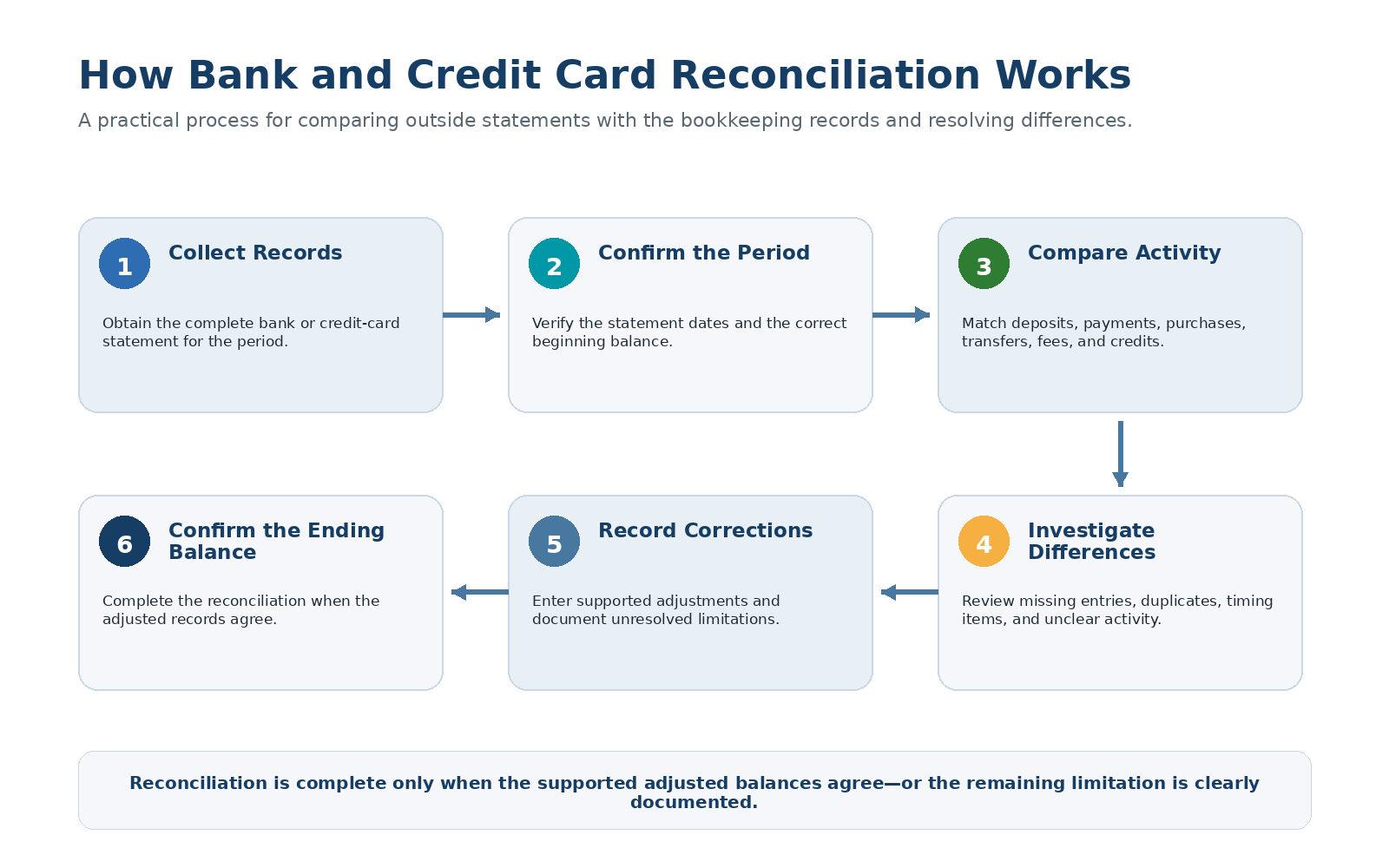
A bank or credit-card reconciliation reviews a defined statement period from beginning balance through ending balance. The bookkeeping activity is compared with the statement, and differences are investigated rather than ignored or forced to match.
The purpose is to create a supported explanation of the account balance. If records are missing or an issue cannot yet be resolved, that limitation should be documented instead of concealed.
Different account activity
Bank Accounts and Credit Cards Are Reviewed Differently
Both accounts should agree with their statements, but the activity being reviewed is not identical. Bank accounts often involve deposits, withdrawals, checks, ACH activity, and transfers. Credit cards often involve purchases, payments, refunds, credits, interest, and fees.

A common misunderstanding
A Bank-Feed Match Is Not the Same as Reconciliation
Matching an imported bank-feed item can help connect one transaction with an entry in the books. It does not prove that the entire statement period is complete or that the beginning and ending balances are correct.
A full reconciliation uses the complete statement, confirms the period, reviews unmatched or duplicated activity, and explains the ending balance.

Why the distinction matters
A Complete Period Can Still Contain Hidden Differences
- A transaction may be missing from the books.
- The same transaction may have been entered twice.
- A transfer may have been recorded on only one side.
- A statement fee, credit, refund, or interest charge may be absent.
- An old uncleared item may be carrying forward incorrectly.
Seeing the adjustment logic
Why the Statement Balance and Book Balance May Initially Differ
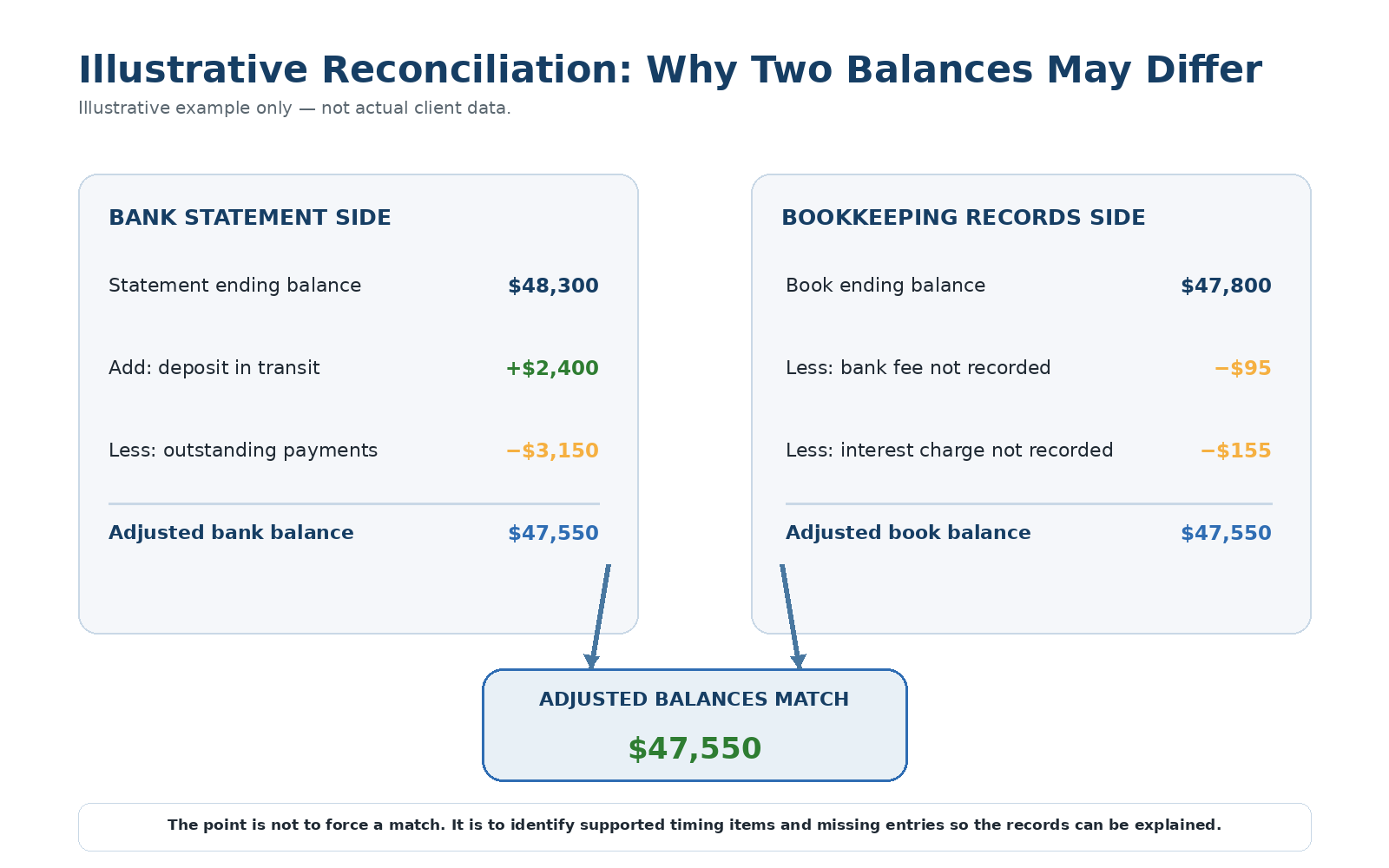
Some differences are timing items. Others represent missing bookkeeping entries that need to be recorded. The objective is to reach an explained, supported balance—not to force the two sides to agree without evidence.
What the review can reveal
Common Reconciliation Differences
Missing Activity
A payment, deposit, purchase, fee, refund, or credit may appear on the statement but not in the books.
Duplicate Transactions
Imported and manually entered activity may create duplicate income, expenses, or payments.
Timing Items
Deposits or payments may be recorded in the books before they clear the outside account.
Incorrect Transfers
A transfer may be missing one side, duplicated, or posted as income or expense.
Old or Uncleared Items
Stale activity can remain open and distort the balance when prior periods were not completed correctly.
Unsupported Adjustments
An adjustment without source records or a clear explanation may need additional review rather than immediate acceptance.
Records commonly needed
What Supports a Reconciliation
- Complete bank statements for the period.
- Complete credit-card statements for the period.
- Loan, merchant-processor, payroll, or transfer records when relevant.
- Receipts, invoices, or explanations for unclear transactions.
- Access to the bookkeeping file and prior reconciliation history.
Common blockers
What Can Delay Completion
- A missing statement or incomplete statement period.
- An unexplained beginning-balance difference.
- Missing details for transfers, payments, or owner activity.
- Old unreconciled periods that affect the current beginning balance.
- A bookkeeping file with duplicate or incomplete imported activity.
The reporting connection
How Reconciliation Supports More Reliable Financial Reports
Reconciled accounts provide stronger support for the balances used in the financial reports. They can help improve the reliability of the profit and loss statement and balance sheet, while supporting a more complete month-end bookkeeping process.
Monthly Bookkeeping
Regular reconciliation helps keep current periods organized and reviewable.
QBO Cleanup
Cleanup may be needed when old differences, duplicates, or balance problems already exist.
Catch-Up Bookkeeping
Prior periods may need to be completed before current reports can be relied upon.
Tax Preparation
Organized, reviewable records can support smoother preparation and reduce unresolved questions.
Common questions
Questions About Bank and Credit Card Reconciliation
Does matching every bank-feed transaction mean the account is reconciled?
Not necessarily. Feed matching reviews individual imported items. Reconciliation confirms the complete statement period, beginning balance, ending balance, and any remaining differences.
Can reconciliation correct every bookkeeping problem?
No. Reconciliation can reveal differences and improve balance support, but broader categorization, loan, payroll, merchant-processor, owner-transaction, or historical cleanup issues may require additional review.
Why might the beginning balance be wrong?
Prior-period differences, changed or deleted reconciled transactions, opening-balance issues, or incomplete earlier work can affect the current beginning balance.
What happens if a statement is missing?
The complete statement is normally needed for a full statement-based reconciliation. The account may need to remain open, or the limitation should be documented until the record is available.
How often should accounts be reconciled?
For many small businesses, bank and credit-card reconciliation is part of the monthly bookkeeping process. The exact frequency and accounts covered depend on the business and the agreed scope.
Connected resources and services
Need Help With Accounts That Do Not Reconcile?
Monthly bookkeeping may help keep current accounts reconciled. QuickBooks Online cleanup or catch-up bookkeeping may be needed when unresolved differences already extend into earlier periods.