Small Business Bookkeeping Explained
Month-End Bookkeeping and Reconciliation for Small Businesses
Month-end close is the process of reviewing, reconciling, and documenting a business’s books for a defined monthly period.

A repeatable monthly process
What Month-End Close Means
Closing the month does not simply mean downloading a report. The underlying activity should be reviewed, relevant accounts should be reconciled, missing records should be requested, and unresolved limitations should be documented.
A consistent close process helps create more reliable monthly reports and reduces the chance that unresolved bookkeeping issues carry forward unnoticed.
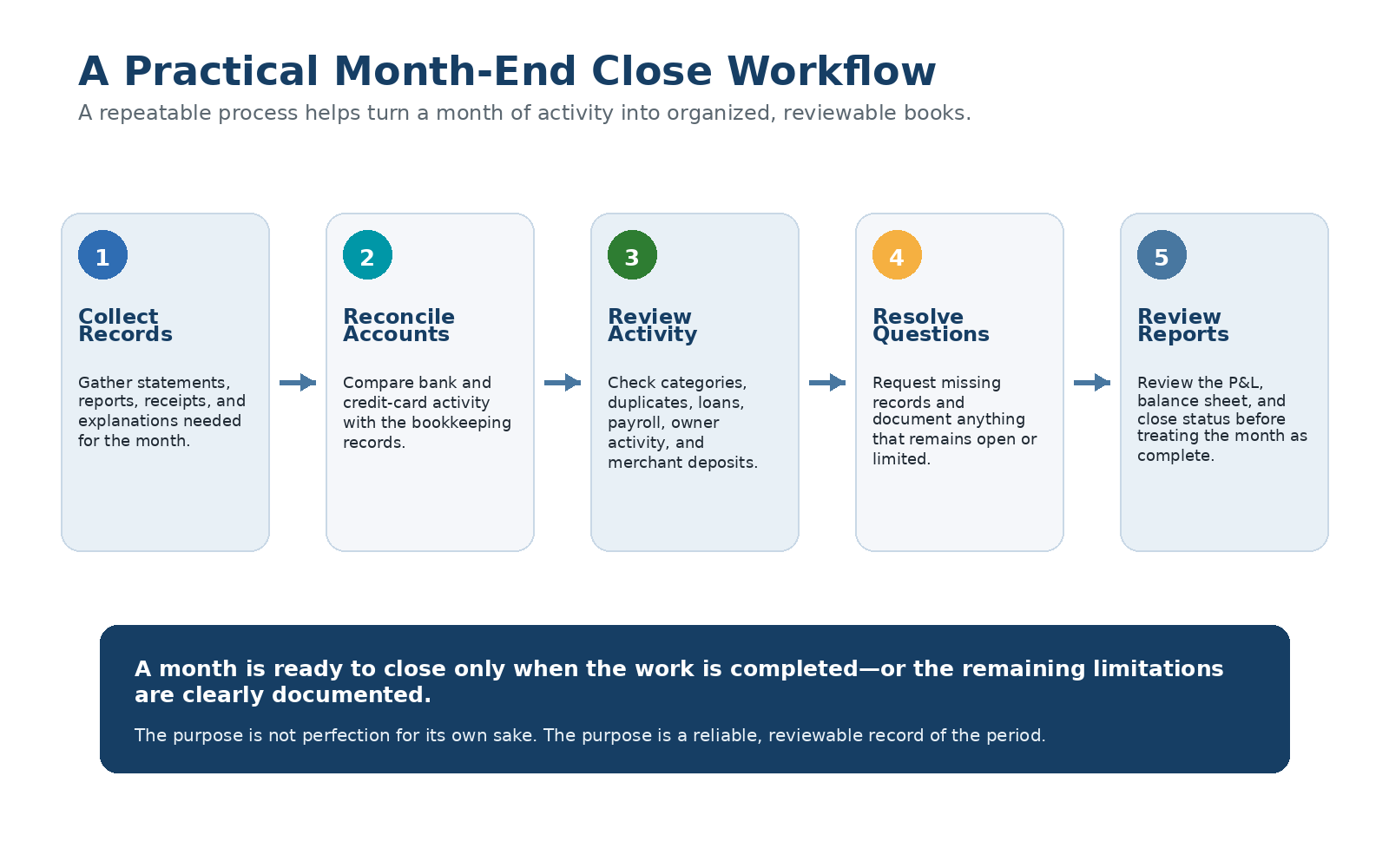
The records behind the reports
What May Be Reviewed During Month-End
The exact review depends on the business and the agreed scope. Common areas include bank accounts, credit cards, loans, merchant processors, payroll activity, owner transactions, missing records, and tax-sensitive activity.
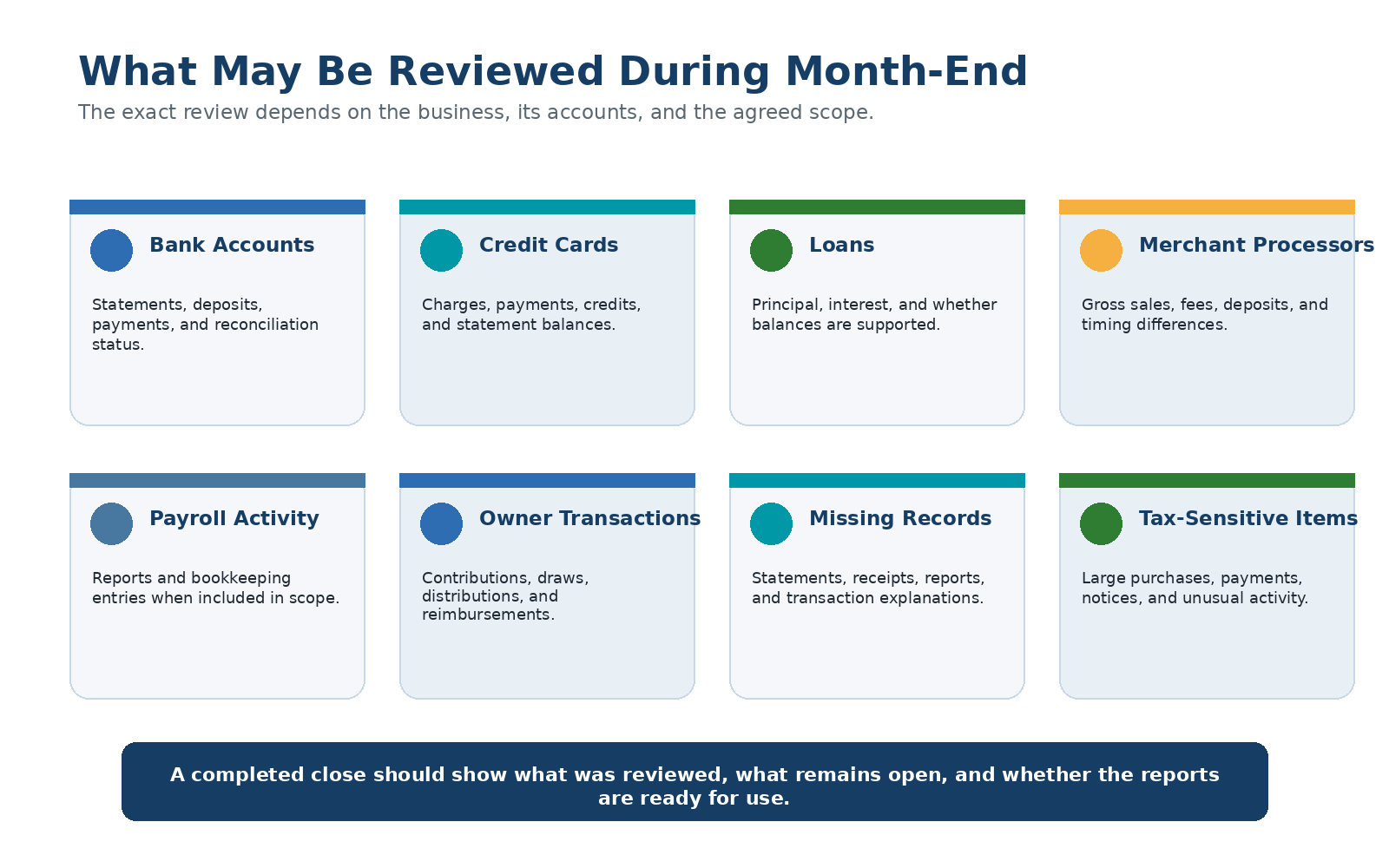
Matching the books to outside records
How Reconciliation Works
Reconciliation compares the bookkeeping records with an outside source, such as a bank or credit-card statement. The goal is to identify why the two records differ and determine whether the difference comes from timing, missing entries, duplicates, fees, or another issue.
A reconciled account provides stronger support for the balances used in the financial reports. It does not mean every possible issue in the business has been resolved.


Why the process matters
What Reconciliation Can Help Reveal
Missing Transactions
Activity may appear on the statement but not in the bookkeeping records.
Duplicate Entries
The same activity may have been entered more than once.
Timing Differences
Deposits or payments may clear in a different period than they were recorded.
Unexpected Charges
Fees, credits, transfers, and other activity may need review or classification.
Common month-end blockers
What Can Delay the Close
- Missing bank, credit-card, loan, payroll, or merchant reports.
- Unanswered questions about unusual or unclear transactions.
- Disconnected feeds or incomplete imported activity.
- Old unreconciled differences carried forward from earlier periods.
- Unclear owner, loan, payroll, or merchant-processor activity.
The practical result
What a Completed Close Supports
- A more reliable profit and loss statement.
- A more reliable balance sheet.
- Earlier identification of missing documents and unresolved issues.
- Better coordination with tax preparation when the books are needed for filing.
- A clear record of what was completed and what remains open.
Common questions
Questions About Month-End Bookkeeping
Does every business use the same month-end checklist?
No. The review depends on the business’s accounts, transaction types, payroll, loans, merchant processors, record quality, and agreed bookkeeping scope.
Is the month closed if a statement is still missing?
A missing statement can prevent full reconciliation. The period may need to remain open, or the limitation should be clearly documented until the record is available.
Why can a report change after reconciliation?
Reconciliation may identify missing transactions, duplicates, fees, credits, transfers, or classification problems. Correcting those items can change the financial reports.
Does month-end bookkeeping include tax preparation?
Not automatically. Monthly bookkeeping can support tax preparation by maintaining organized records, but tax preparation and filing are separately scoped unless the engagement says otherwise.
Connected resources and services
How This Connects to the Rest of the Bookkeeping Process
Monthly bookkeeping helps keep the current period organized. QBO cleanup may be needed when the existing file is unreliable. Catch-up bookkeeping may be needed when prior periods are behind. Tax preparation depends on organized, reviewable records.